
Not all stress harms performance. Moderate, manageable stress (eustress) can sharpen focus and raise output, while too little or too much stress reduces it. The relationship is not linear: optimum performance usually sits at an intermediate level of arousal.
What is the difference between eustress and distress?
Hans Selye, who established much of modern stress research, distinguished eustress from distress. Eustress is the form of stress experienced as a challenge that feels demanding yet manageable. It is typically short-term, linked to a sense of control or self-efficacy, and associated with heightened alertness, motivation, and a feeling of engagement. Distress, by contrast, is the form experienced as overwhelming or threatening. It can be prolonged, is linked to lower perceived control, and is more likely to produce anxiety, impaired concentration, and eventual exhaustion.
The same physiological activation (increased heart rate, hormonal response) can underlie both. The difference lies largely in appraisal: whether the demand is seen as a challenge one can meet or a threat that exceeds available resources. A tight deadline on a project one feels prepared for can produce eustress; the same deadline after prolonged overload and insufficient recovery is more likely to produce distress.
How does the Yerkes-Dodson law explain optimum stress?
The Yerkes-Dodson law, first demonstrated in 1908, describes the relationship between arousal and performance as an inverted-U curve. At low levels of arousal, performance is typically weak (boredom, low motivation, reduced attention). As arousal rises to a moderate level, performance improves—attention sharpens, effort increases, and efficiency rises. Beyond an optimal point, further increases in arousal lead to declining performance (errors, narrowed attention, impaired working memory, and reduced flexibility).
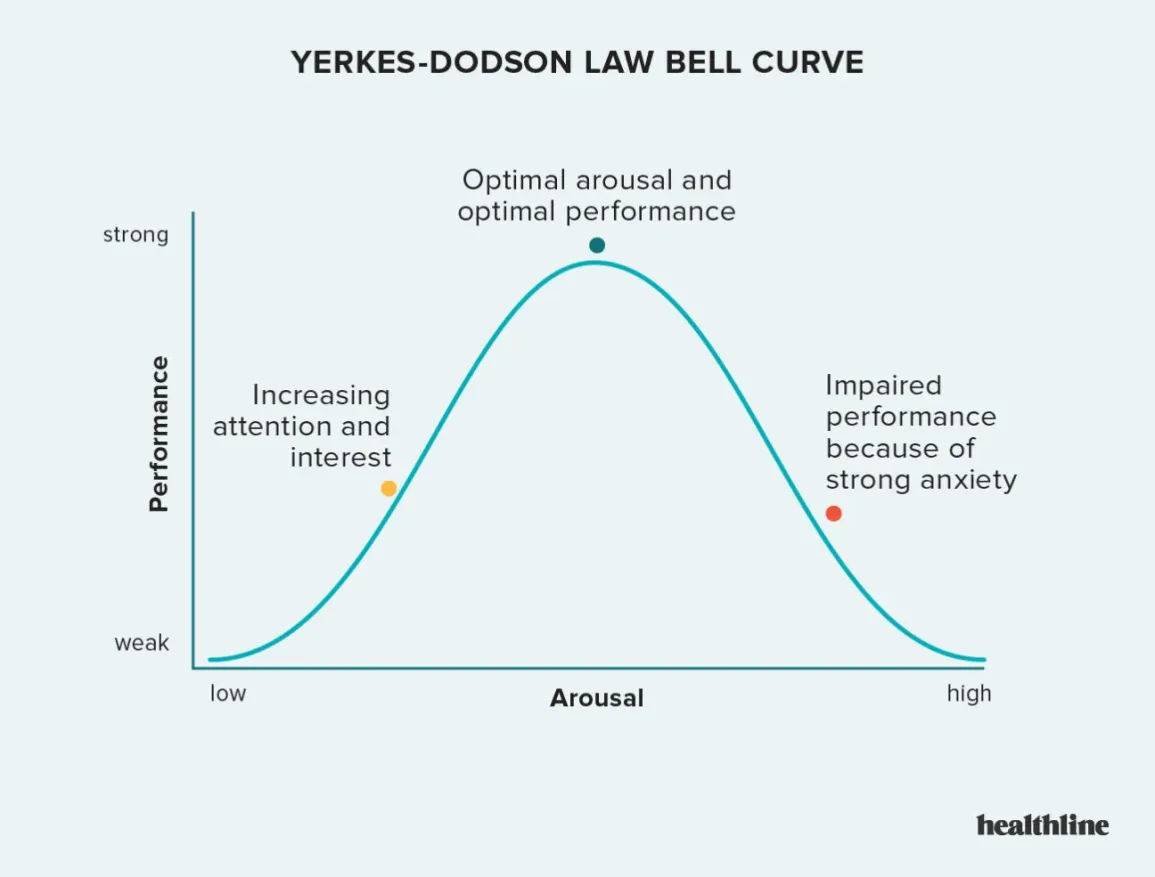
The location of the peak depends on the task. Simple or well-practised tasks can often tolerate higher arousal before performance drops. Complex, novel, or high-stakes tasks that require working memory and flexible thinking usually reach their peak at lower levels of arousal; excess pressure impairs them more quickly. In practical terms, the “optimum stress” zone is the range in which activation supports the cognitive and motivational demands of the specific task without overwhelming them.
How can you stay in the optimum stress zone?
Because the optimal level is not fixed, the practical task is to notice when arousal is too low or too high for the work at hand and make small adjustments. When arousal is too low, introducing a clear deadline, a modest challenge, or accountability can raise engagement. When arousal is too high, reducing simultaneous demands, inserting short recovery periods, or reframing the task as a manageable challenge rather than a threat can bring it back toward the middle of the curve.
Perception of control matters. People who view a demand as within their capacity are more likely to experience it as eustress; those who view it as exceeding their resources are more likely to experience distress. Brief preparation, breaking a large task into smaller steps, and ensuring recovery after intense periods all help keep demands inside the manageable range. Chronic high arousal without recovery shifts the system toward distress even if the original demand was moderate.
Practical checklist: Finding and using optimum stress
- Identify the current task’s complexity (simple/routine vs complex/novel).
- Notice your current arousal (low energy/boredom, focused energy, or overwhelm/anxiety).
- If arousal is too low for the task, add a modest constraint (time limit, accountability, or clear next action).
- If arousal is too high, reduce concurrent demands, take a short recovery break, or reframe the demand as a specific, solvable challenge.
- After intense periods, deliberately insert recovery so that temporary eustress does not become prolonged distress.
- Review outcomes periodically: did the level of pressure improve focus and output, or did it increase errors and fatigue?
Key takeaways
- Stress is not uniformly harmful; moderate, manageable stress (eustress) can improve attention, motivation, and performance.
- Distress arises when demands feel overwhelming or prolonged, reducing control and impairing cognitive function.
- The Yerkes-Dodson law describes an inverted-U relationship: performance rises with arousal up to an optimal point, then declines.
- Optimal arousal is lower for complex or novel tasks and can be higher for simple or well-practised ones.
- Staying near the optimum involves adjusting demands, recovery, and appraisal so that activation remains supportive rather than overwhelming.
References
- Selye, H. (1974). Stress without distress. J. B. Lippincott.
- Selye, H. (1976). Stress in health and disease. Butterworths.
- Yerkes, R. M., & Dodson, J. D. (1908). The relation of strength of stimulus to rapidity of habit-formation. Journal of Comparative Neurology and Psychology, 18(5), 459–482.
- Lazarus, R. S., & Folkman, S. (1984). Stress, appraisal, and coping. Springer.
- Diamond, D. M., Campbell, A. M., Park, C. R., Halonen, J., & Zoladz, P. R. (2007). The temporal dynamics model of emotional memory processing: A synthesis on the neurobiological basis of stress-induced amnesia, flashbulb and traumatic memories, and the Yerkes-Dodson law. Neural Plasticity, 2007, 60803.

About the author
Dr. Hunny Kalra, PhD, is an Educator, Research Psychologist and Transformation Coach, and Assistant Professor of Psychology at Jain (Deemed-to-be University), Bengaluru. His work translates psychological science into practical tools for real-life challenges.
This article is for general information and education. Dr. Hunny's services are mentoring, coaching and consulting; they are not therapy or medical treatment. If you are in distress, please contact a qualified mental health professional, call Tele-MANAS on 14416, or dial 112 in an emergency.
Explore how I can help
Mentoring, coaching and consulting grounded in psychological science.