
Who we choose to watch shapes what we become. The right models accelerate growth; the wrong ones limit it. This article explains how observational learning works, using Rachin Ravindra’s comments on Virat Kohli and Rohit Sharma, and shows how to apply Albert Bandura’s framework in research, career, and performance.

Why do the people we idolise matter so much?
People learn a large part of their behaviour by watching others, not only through direct experience. Albert Bandura’s social learning theory demonstrated this through the Bobo doll experiments: children who observed an adult acting aggressively toward a doll later reproduced specific aggressive acts even without personal reward (Bandura et al., 1961). When the model was punished, imitation dropped. This is vicarious learning — learning from the outcomes we see happening to others (Bandura, 1977).
Rachin Ravindra recently described exactly this process. He said Kohli and Rohit are “two players I have idolised for years, modelled parts of my batting on and learnt little things from” (Times of India, 2026). He specifically noted Kohli’s play in bouncy conditions and Rohit’s approach to spin, along with their grit and determination.
How does observational learning actually work?
Bandura identified four processes that must occur for modelling to succeed (Bandura, 1977, 1986):
- Attention — Notice the model’s behaviour and its results.
- Retention — Store what you observed as a mental representation.
- Reproduction — Practise translating the observed behaviour into your own actions.
- Motivation — Reproduce the behaviour when the model’s outcomes are valued (vicarious reinforcement).
Practical checklist for choosing and using models:
- Select models whose results you respect and whose methods you can observe clearly.
- Focus on specific behaviours and the conditions under which they succeed.
- Mentally rehearse and deliberately practise what you observe.
- Check that the model’s rewards match the outcomes you actually want (consistency, impact, ethical standards, wellbeing).
This process applies equally in research, leadership, sport, and personal performance.
What are the common limitations?
Observational learning is powerful but not automatic. People tend to model those who appear competent or high-status, yet attention is limited. Watching models who succeed through shortcuts or inconsistent effort can transmit those patterns just as easily as positive ones. Without deliberate reproduction and practice, observation alone rarely produces lasting change. The quality of the models you allow to occupy your attention sets a practical ceiling on the standards you adopt.
Key takeaways
- Much of what we learn comes from watching others and the consequences of their actions (Bandura, 1977).
- Four processes — attention, retention, reproduction, and motivation — determine whether modelling succeeds.
- The models we choose shape the standards we internalise in research, career, and performance.
- Deliberate selection and practice of high-quality models is one of the higher-leverage decisions available for growth.
References
- Bandura, A. (1977). Social learning theory. Prentice Hall.
- Bandura, A. (1986). Social foundations of thought and action: A social cognitive theory. Prentice Hall.
- Bandura, A., Ross, D., & Ross, S. A. (1961). Transmission of aggression through imitation of aggressive models. Journal of Abnormal and Social Psychology, 63(3), 575–582. https://doi.org/10.1037/h0045925
- Times of India. (2026). Rachin Ravindra reveals how Virat Kohli and Rohit Sharma have shaped his batting. https://timesofindia.indiatimes.com/sports/cricket/news/rachin-ravindra-reveals-how-virat-kohli-and-rohit-sharma-have-shaped-his-batting/articleshow/135006371.cms
About the author
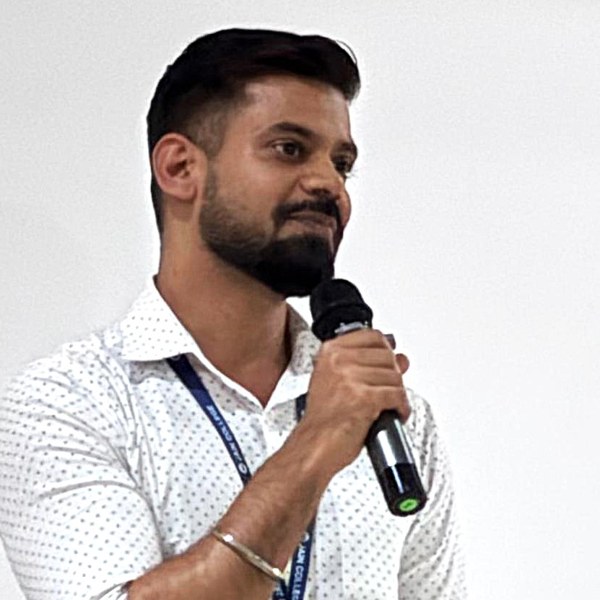
Dr. Hunny Kalra, PhD, is an Educator, Research Psychologist and Transformation Coach, and Assistant Professor of Psychology at Jain (Deemed-to-be University), Bengaluru. His work translates psychological science into practical tools for real-life challenges.
This article is for general information and education. Dr. Hunny's services are mentoring, coaching and consulting; they are not therapy or medical treatment. If you are in distress, please contact a qualified mental health professional, call Tele-MANAS on 14416, or dial 112 in an emergency.